Saturday, November 27, 2021

 THE UAE - NOW & THEN


The UAE is fast emerging to be a salad bowl of cultures and traditions and the home to approximately 200 nationalities. I call it a ‘salad bowl’ rather than a ‘melting pot’ as I have my reasons for it. In a melting pot, every ingredient loses its individuality and uniqueness and assimilates into one single entity. Whereas in a salad bowl, every ingredient retains its individual flavor, colour, appearance while contributing to the rich diverse bowl of oneness and unity. The UAE is exactly the place to be in where you celebrate diversity, individuality, and identity while being an integral part of the UAE’s rich multiculturalism. It is a place where many cultures, traditions and customs co-exist peacefully and in harmony.

At Little Oxford Nursery and Day Care, we celebrate UAE traditions with our little ones. By employing props, realia, roleplay, modeling and recreation as part of our lesson plans, we introduce our young learners to the various traditions and customs of the UAE.

The UAE Cuisine: The UAE cuisine is a combination of several spices and ingredients such as saffron, cardamom, cinnamon, cloves, dates, honey, etc. The Emirati ladies dressed in their traditional attire serve gahwa, harees, kabsa, maqluba and luqaimat with great fondness and love.


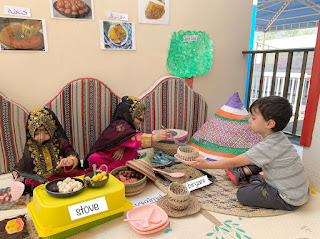
The Arabic Coffee: The Arabic coffee symbolizes hospitality and generosity - an integral value of the Emirati tradition. Arabic coffee is served in a beautifully designed kettle known as dallah and is served while holding it in the right hand, with the thumb pointing to the top and the cup in the right hand. The cup is filled only one-quarter full, which can be refilled, if required. The guest receives the cup with their right hand and after drinking the coffee it should be returned to the server. Coffee is first served to the oldest and the most important guest. One should drink at least one but not exceed more than three cups of coffee.


Falconry: Falconry is an integral part of the UAE’s Bedouin culture dating back to several centuries. Saqr as it is known in Arabic - the falcon is a symbol of poise, strength, bravery, elegance, determination and composure. Initially, as food was scarce, falcons were used for hunting down bustards and curlews for food. As times changed, the falcon was no longer required to hunt for survival of the desert inhabitants. However, the bird did not lose its prominence in the Emirati culture. It is still their favourite bird used for sport.


Henna: Brides without henna in the UAE is an impossible proposition. Henna signifies good luck, beauty, blessing and happiness. A paste made of henna leaves, water and sometimes coffee powder or lemon juice, is filled in cones and intricate designs are applied on hands/feet. It turns brown when left for some hours. It is also worn on occasions outside wedding parties, such as religious festivals, national events and even birthday parties. When its henna, its celebration time – a matter of the heart.

Games: In the past, Emirati parents could not afford toys for children, which led to the children inventing their own games and toys, which became entrenched in the UAE culture. Even today these games are played with great fondness. Earlier games were gender driven, boys played games that were more active and played outdoors whereas girls took on games that echoed the roles they would take up in future life. By sunset, or the call of the Maghrib prayer, all games would end and children would be back in their homes. ‘Al Ghomaid’ was a blindfold game played by both genders; ‘Salwa’ game was for both genders and was played by holding hands to form a circle. The circle opens wide and closes as a flower does on the tune of a song sung by the kids.

After 50 years of its inception, the UAE today stands tall with accolades and achievements of great value and pride. It is now recognized as the business capital of the Middle East and the wealthiest nation in the region. The diversification of its economy has led to less dependency on oil revenues. It is now a role model for others to emulate. With modern infrastructure, booming tourism, and influx of private and foreign investments, there is no looking back. However, with all the progress and growth, the UAE and its people have not forgotten its rich past.

The modern UAE is a fabric of traditions, cultures, customs and modernism woven with the loving hands of its visionary leaders and humble people.

Pictures: Courtesy - Little Oxford Nursery and Day Care


Thursday, November 18, 2021


Turn off the Reel – Turn on the Real


The question - Can creativity be fostered or hampered by adults in children?


The answer – A resounding YES


In the ever-changing world scenario, children need to have creative skills that are required to cope with challenges in these demanding, technologically driven times. I lay emphasis on the term ‘technologically driven’ as our very young are undoubtedly addicted to devices with unlimited screen hours which is not only detrimental to their physical health, speech and language development, social interactions, cognitive progression but also to their creativity and imagination. The very limited number of hours they get to interact with nature, real objects, real people and real situations hampers their independent thinking and thus deprives them of the vital aspect of development and learning.


Inspiring creativity in kids is the responsibility of adults. Our kids need to be innovators, critical thinkers, problem solvers, and valuable global citizens contributing to the growth and development of the world and everything in it. Most adults have experienced difficulty in thinking out of the box, acting creatively and bringing innovation in their work - the reason being - as kids creativity was neither attended to nor fostered in them. They were not provided with opportunities that would bring forth imagination and novelty. Therefore, as adults, we need to commit ourselves towards the attainment of this vital skill in our young.


How do we promote creativity in our young? 
Here are a few takeaways which if practiced in its true spirit will yield remarkable results:

1. Turn off the reel – turn on the real: Switch off that device, get up from your couches, go out of your homes and enjoy the outdoors. When your child sees and experiences the natural, he becomes a lover of nature and we all know that nature inspires creativity, instills a sense of contemplation and exploration. A simple walk may turn out to be an adventure for your little one, for instance a caterpillar opens a world of imagination, questions and expressions.

2. Don’t crush their imagination: Kids have an unlimited sense of imagination. They have the potential of thinking of the weirdest, funniest and the silliest of things. When you happen to ask them about their opinion or an idea, they may come up with ideas that may not make sense to you at all. However, do not brush off their contribution as something ridiculous, do not mock or disregard their ideas. This may dampen their self-esteem, crush their imagination, discourage them from thinking a new and most importantly limit their thinking.

3. Lead them to the desired outcomes: No matter how absurd their ideas may be, lead them to the outcome that you desire by asking ‘what, why, how, when and who questions’. This enables them to think practically, feasibly and find satisfaction in being a constructive member of the family. This will exercise their grey cells and will motivate them to be independent, pragmatic thinkers.

4. Every child should own a creative space: Dedicate a corner in your child’s room to express his creativity. This space provides the child with the independence to unleash his creativity. The space may look to be an eye sore but respect the space. It is his kingdom of expression, he owns it, so let him rule over the space. It is not only a physical space but a mental space, a space of pride where the child’s ideas, imaginations and fancy reign with complete authority.

5. Every artwork is a masterpiece: A flower may not look like a flower from the remotest angle, a tree may be black, an apple may be blue, however, it is his creation and he has put in immense effort and hard work to create it. It gives him great pride and nurtures his self-esteem. Make your praise genuine and compliment the part of the art work that really stands out. It need not be something outstanding or special but as simple as the choice of colours, or his ability to colour within the lines. As you praise, slip in a recommendation that allows him to think of doing things differently. Henceforth, every time he creates, he creates with more understanding, reason and flair, thus, gradually improving with every attempt.

6. Brainstorm ideas and suggestions: Provide your child with real-life situations and ask him to think of solutions. Such exercises will help him to overcome the future life challenges awaiting him as an adult for e.g if one of the siblings looks sad, ask him for the reason and solutions; or when rearranging the child’s room and decorating it, ask for his opinion and suggestions. Let them know that their opinion matters, that in turn help in developing their innovative problem solving skills.

7. Choose the right toys: Not every toy fosters creativity and imagination. Most of them are purely for entertainment purposes. Choose toys that allow free play and are open ended, allowing the child endless possibilities of building and creating without the constraints of following rigid rules. Toys such as dolls, puppets, 3D models of humans and animals provide numerous opportunities to nurture imagination and fancy role plays. Puzzles, LEGOs, play dough, construction and manipulative toys and blocks do not impose a limit on the child’s thinking but opens an entire new world of creation, innovation, novelty and production.

8. Creativity is not restricted to art and craft: Creativity is not restricted to art and craft but is extended to include music, dance, and drama. Be attentive, and learn about your child’s interest and provide him with the right material, resources and tools. If your child is inclined towards drama and acting, provide him with costumes, props, tools and a DIY stage in the corner of your house. These may be inexpensive, old, discarded items from your backyard, from the attic or from your store. Recycling the old stuff is a lesson in itself. You are leading by example and setting the tone of creativity, imagination by being resourceful and thinking out of the box.

9. Welcome the mess: Do not frown when your child makes a mess while creating. Even in the mess, the child sees a wonder, he imagines and creates. Messy play is a way of relaxing, unwinding and a soothing activity for children. Finger paint, gloop and slime, paint and natural elements such as sand, water, ice etc, are a few of the items used for messy play. It does not only provide children with enriching sensory experiences but also with a treasure of language and vocabulary.

10. Read books: Read aloud to your child from books that bring characters to life. By visualizing the characters, events and the settings; by asking about the possible end to a story, you are inculcating in your child the skill of solving the unsolved and unraveling the threads of mystery and enigma.

Creativity is all about self-expression. When kids have the freedom to express themselves without any fear of being judged or criticized, they grow into emotionally healthy individuals who are aware of their individual unique self, respect diversity, and appreciate and contribute to the world around them positively.


Saturday, November 13, 2021

 Literacy Development In Action

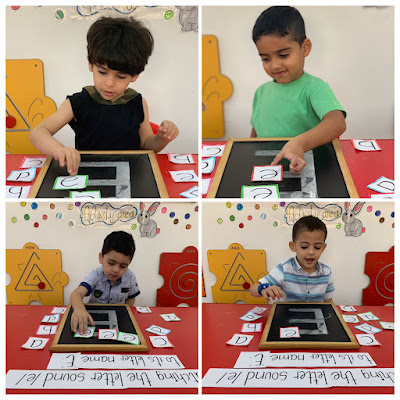
At LONDC, we ensure that our little ones have strong literacy foundations through consistent and continuous support extended by our loving and caring staff. They introduce phonemes and graphemes using various strategies, techniques and methods that capture the little minds and interest. 
Simultaneously they focus on language and speech development through activities such as singing rhymes; phonic games; role play; everyday fun activities; art and craft; pictures and objects; sight words and reading stories to them followed by group discussions.

Story - The Smartest Giant in Town

Reading Stories

/d/ - dinosaurs in tuft tray

So much more of /d/.........

/e/ - envelope, engine, elephant, egg and ..........

Sight Word Hunt

Promoting Literacy through Technology  


Tuesday, November 09, 2021

 Social Development in Young Children

“Through others we become ourselves” 

Lev S. Vygotsky


Social development tends to take a backseat when parents talk about the overall development of their children. They are more concerned about their children’s physical, speech and language development and of course, their academic accomplishments. However, parents tend to ignore social development – a vital piece that underpins the holistic development of a child’s personality.

Children learn and discover many aspects about themselves when they interact with people around them. In the process, they make friends; learn about the differences that exist between individuals, and exchange views and opinions. They learn compassion, empathy and become emotionally intelligent. They learn to take turns, share personal belongings, indulge in cooperative play and reach amicable solutions to disputes and disagreements. They become more independent, less selfish, feel secure and appreciate their self and identity and ultimately develop self-esteem and respect for others.

Parents Make the Difference:

Speak out: Encourage young children to speak their mind out. Instead of showing aggression, getting frustrated or feeling low or angry, children should be taught to express their feelings. They should be encouraged to use words instead of actions.

Divert: There will be times that children may lose their cool, get angry and retaliate. In such situations, it’s important that you take them away from the scene, try to calm them down so that they do not hurt other children, and divert their attention. When calm, talk about the unacceptable behavior and that you understand his/her feelings but do not accept the behavior of physically assaulting others; communicate your displeasure and disapproval of the same. Teach them peaceful ways to resolve conflicts.

Apologize: Only after the child has realized the wrong done, ask him/her to apologize to the wronged child. Just verbal service may not bring about the desired change in behavior, but a little time spent on making him/her realize why the behavior is not acceptable, will go a long way in getting required results.

Walk the Talk: Speaking about good behavior is less effective unless it is modelled by your actions. Don’t just talk the talk but walk the talk. When you control your anger, your child gets to see your words of advice of patience and self-control in action. You become your child’s role model. They children learn through imitation and modeling.

Turn takings: They should be taught that when two are playing, each member gets a turn and the other member has to patiently wait for his turn to come. Thus, each member gets equal and a fair chance. Your child gets to practice patience, self-control and tolerance.

Role play and make-believe games: Young children love to indulge in imaginative play. It allows their curiosity and discovery to run wild; unboxes their possibilities to explore and encourages cognitive as well as social play. It tends to foster cooperative play, communication, problem-solving and more complex social ideas as they take on roles of their choice.

Play sessions: Arrange for play dates for your child with his preschool peers, friends, neighbouring children and with children from your extended family. This will help them to lead an active social life boosting their self-esteem and provide opportunities to make friends. Invite your child’s friends to your home; it gives your child a sense of delight as he/she takes pride in showing off his possessions, home and family to his friends. This does not mean that your house has to be sprawling, lavish and luxurious filled with expensive and latest gadgets and toys. A home is made of warm and loving people. Your child’s playmates actively influence your child’s thinking, attitudes and behavior. Your child will have a broader view of the world around them. They discover that there are many different values, opinions, and perspectives that they never knew from birth. They learn about new things such as games, trends, clothing, and toys as well as learn new vocabulary.

Sibling rivalry: Sibling rivalry takes root when your children compete with each other to gain your love, acknowledgement and approval. Although it is a phase of growing up, it is your response that decides if the behaviour stays on or fades away. If not addressed earlier on in life, it permeates from self to others and reflects in the child’s behavior and attitudes for a longtime. This in turn negatively affects your child’s self-esteem, social interactions and relationships. As a parent, you have to:
  • treat your children equally, respect them for their uniqueness and fulfill their individual needs;
  • avoid comparing children’s abilities and then praising one specific child in front of others;
  • encourage your children to settle their own disagreements and disputes;
  • set the rules of acceptable and unacceptable behavior and consequences of unacceptable behavior;
  • discourage children from criticizing each other;
  • anticipate forthcoming problems and devise solutions;
  • encourage and compliment good behavior and nurture sense of familial ties;
  • draw the line between bad behavior and your child – you dislike the unacceptable behavior and not your child - express your love and support your child to attain the desired behavior.
Last but not the least, you have to model and nurture healthy relationships and build robust communication channels within your family.

"A happy family raises a healthy body, mind and soul."